
Consolidated Vendor Pickup
Your inbound logistics, optimised before the supplier ships.
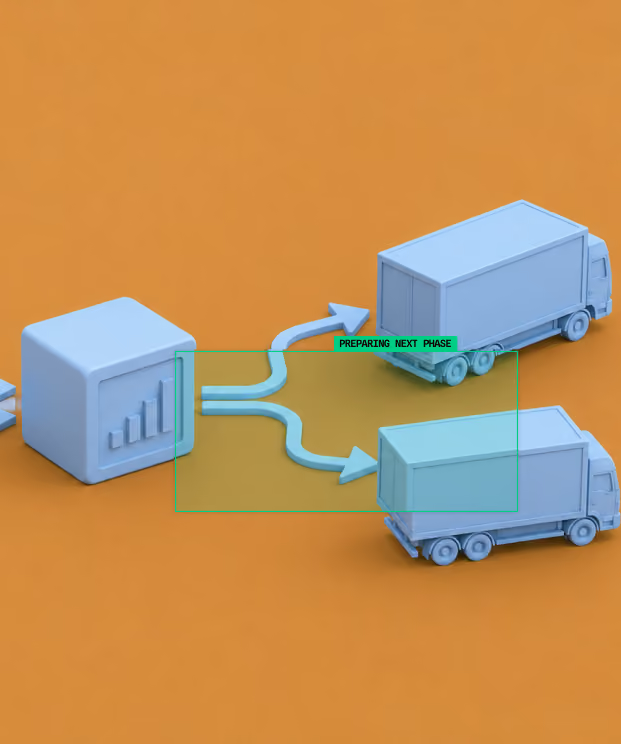
Mojro schedules supplier arrivals, consolidates inbound loads, and aligns dock capacity - all in a single optimisation run and as part of the full transportation network. Your DC gets what it needs, when it can handle it.
The Problem
Most inbound problems
don't start at the dock
but in the planning.
Loads that could share a vehicle run as separate trips because consolidation is never computed.
DC's receiving constraints - dock doors, staff, and unloading time are ignored until teams discovers on arrival.
Supplier delays, early arrivals, and load changes are discovered at the dock, when it's already too late.
Suppliers book ad-hoc delivery slots, and multiple deliveries arrive at once.

Capabilities
Inbound planning was never meant to be solved in isolation. Here's what changes when it isn't.
01 Supplier time window alignment
Stop multiple trucks arriving at the same dock at the same time.
Mojro schedules inbound supplier arrivals against real dock availability and receiving capacity. No more congestion due to independently scheduled deliveries arriving simultaneously.

02 Load consolidation
Combine vendor loads. Run fewer trips.
Consolidate multiple supplier loads onto fewer vehicles without violating time windows or product compatibility constraints.
03 Inbound trip minimisation
Move the same volume in fewer trips - every single cycle.
Space, weight, schedule, and trip count are solved simultaneously. Mojro identifies the minimum viable trips to move the required inbound volume.
04 DC throughput integration
Plan inbound around your DC capacity.
Dock doors, receiving staff, and unloading time by product type are modelled as hard constraints. Inbound plans accounts for warehouse capacity.
05 Cross-leg visibility
A supplier delay shouldn't be a dock-side surprise.
Inbound arrival timing feeds directly into mid-mile and outbound planning. A supplier delay is visible to the full optimizer and not discovered at the dock.

06 Dynamic re-planning
Supplier late. Load changed. Plan updated - automatically.
Plans update and re-optimize automatically to adjust for late or early deliveries and load changes, without a planner having to catch it first.

Inbound Patterns
One optimization run. Three ways it works in the field.
Multi-stop inbound
Multiple supplier loads consolidated into the minimum viable inbound trips to a single DC.
- Space and weight optimised before a new trip is created
- Supplier windows and dock constraints enforced as hard constraints
- Multi-supplier loads combined onto shared vehicles

Cross-dock and continuous flow
Multi-compartment vehicle routing across multiple suppliers in an optimised pickup sequence to minimize inbound distance while meeting all collection windows.
- Optimal pickup sequence computed with load compartment assignment
- Product and temperature zone types assigned simultaneously
- Suppliers grouped based on volume and location
Milk run and network alignment
Long-haul inbound lanes optimised with intermediate cross-dock identification, relay planning, and mode mix.
- Cross-dock locations identified and evaluated automatically
- Long-haul lanes broken into HOS-compliant relay segments
- Each lane segment assigned optimal mode - FTL, LTL, rail, or multi-modal


What actually changes when Mojro plans your inbound?
10 - 15%
Reduction in number of trips
95% +
on-time pick up SLA's
85-90%
ETA Accuracy to DC
Stop planning inbound in isolation. Optimise in one run.